Coping With Grief
What Twenty Years Of Sitting With The Bereaved Has Taught Me
A first-person view from someone who has sat with Thousands of grieving people over many years.
This isn’t a textbook on grief. It’s the perspective of someone who lost his own father, and who has spent twenty years sitting in a tattoo studio with people in every stage of loss, listening to them. If you’re in the middle of it right now, you’re not on your own, and nothing you’re feeling is stupid or wrong.

Grief After Losing A Loved One
Me and my team have been working with clients who have lost loved ones for over twenty years, and in that time we’ve sat with thousands of grieving people. No two are the same, and yet I keep noticing the same shapes coming up again and again, the same emotions in different orders, the same questions, the same quiet moments when someone realises they’re not the only one who feels this way.
First, the honest bit. This isn’t a one-size-fits-all guide. Everyone is different. Everyone grieves differently, and you should never feel offence at anything written here that doesn’t quite fit your situation. I’m only sharing what I’ve seen, and what I’ve felt myself, so that maybe a small part of it gives you something to hold onto.
The thing is, the funeral itself is a blur for most people. You get through it on autopilot, and then it ends, and afterwards you’re left floating with a strange mix of emotions, some of which you’ve never felt before. Silent rooms, surrounded by a thousand small things that remind you of them, and the stages of grief only get louder in that quiet.

Why Grief Hits Everyone, Differently
You see, the funeral director rarely hears the whole story. They turn up, do the job, let you cry, perform the service you’ve asked for, and that’s the role. Afterwards, you’re left looking online for some kind of answer, and what you find tends to be either generic textbook advice or bitter, broken voices.
For more than twenty years now, sitting in the studio every week creating ashes tattoos, I’ve seen every part of society in every kind of grief. People who’ve lost loved ones to freak accidents, to murder, to hospital mistakes, to long illnesses, to old age. Thousands of stories, thousands of cups of tea, thousands of quiet conversations. One thing is for sure, every story is different, and every person sits in a different stage of it.
But what I’ve learned is that there do seem to be stages, even if no one moves through them in the same way. Some people only ever feel a few of them. Others go through every single one, especially when the death was sudden. I’ve tried to lay them out below. What I’d love this to do, more than anything, is show you that you aren’t on your own with what you’re feeling. We’re all human. The emotions you’re going through are normal, and none of them are anything to be ashamed of, confused about or embarrassed by. We use these emotions to heal.
We use the emotions of grief to heal.
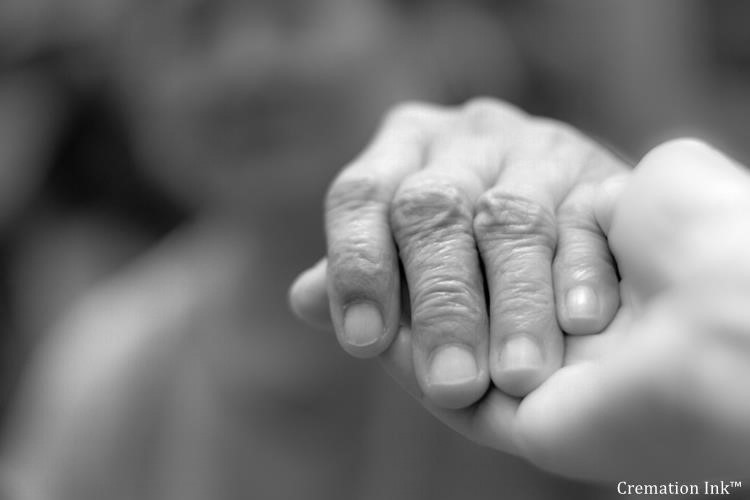
You Never Really Get Over It
Here’s some very honest advice. You don’t get over the loss of someone you love. Ever.
Three years after my father passed, I was walking down a shop aisle and saw some hot chilli sauce. I smiled, thinking he’d love this for Christmas, and was quietly chuffed with my forward planning. It was only when I got to the till that I remembered he’d been gone for three years. Am I going mad? No. They stay in your thoughts, and they always will.
This might sound like a strange way of putting it, but picture a spiky sea urchin sitting inside you. That’s grief. You don’t get over grief. What you do, slowly, is take the spikes off, until you can find a place in your heart where it lives without hurting quite so much.
Someone can have lived the most amazing life right up until they were 60, and then slowly fade in front of you. Grief, especially at first, makes you relive those last awful months on a loop and clouds out the 60 years of incredible life you shared together. The light at the end of the tunnel is that, once the spikes start to come off, you can begin to reach back to the good. You can reminisce. You can remember the times that made you smile. Mine is my dad and that bottle of chilli sauce in a shop aisle.
Hold the analogy in your head. Grief is a spiky urchin you’re carrying inside you. You need to go through the stages to soften the spikes. The longer you hold onto them in their original shape, the more they hurt. You need to grieve. You need to console yourself. You need to gradually smooth them off, so you can embrace the life you shared, the time you spent, and the bond you had, instead of just the loss.

The Stages Of Grief, As I’ve Seen Them
Let’s go through the stages. Remember this isn’t a checklist, and it’s not one-size-fits-all. Everyone’s situation is different. But as you read on, I’m fairly sure at least one of these will speak to you.
Shock
Shock is especially loud when someone is taken from you out of the blue. That small shake of the head when you think about it, the blank patches in your memory of the first days, the strange sense that one minute they were there and the next they were gone. The funeral is over and yet, somewhere in your head, you’re still casually waiting for them to come through the front door, back to your side. They couldn’t have gone. They loved you, and you loved them.
When a loved one is taken from you suddenly, shock kicks in because the natural routine of your life hasn’t yet made space for them not being there.
I’ve talked things through with clients whose partners passed in genuinely upsetting ways, and yet they’re sitting in the chair telling me about it as casually as you’d order a takeaway. It just hasn’t sunk in yet, and for some it can be years before it does. In the army they call it the thousand yard stare. The person is running on basic functions, comforting themselves with the routines of life, because if they don’t recognise that it’s happened, the pain hasn’t fully landed yet. Do I have a clever way of getting past this stage? Honestly, no. Take time away from family, or work if you need to. Sit with what’s happened. Let yourself slowly take in the size of the loss.
There’s a real temptation as I write this to throw in stories and examples for every stage, but I’ve decided against it. I’m not writing this to entertain you. I’m writing it to help you grieve. So I’ll just say this: I see a lot of clients who’ve recently lost someone, and shock is very common, because we as humans deny the loss in order to delay the pain.
Anger
Anger has a lot of faces. If you lost your loved one through someone else’s fault, the anger naturally points outward, at that person and at the system around them. But the one people talk about less, and which is far more common than you’d think, is the anger we point inward. At ourselves. Did I do enough? Could I have done more? Why didn’t I say the words I always meant to say, the ones I assumed I’d always have time for?
You can’t change what’s happened, and anger is a natural part of standing in that. Anger at a system that, for example, made a medical mistake is easily understood. Anger at yourself is harder. Unless you literally took their life (and you didn’t), then the anger you’re aiming at yourself is really regret in a louder coat. You can’t change the past. It sounds simple, and yet in some moments it’s the only sentence that helps.
Don’t beat yourself up with anger. It has a way of bleeding into the rest of your life. Lashing out at the people still here, because of the pain of the one who isn’t, can damage the relationships you need now more than ever.
I’m not saying don’t get angry if it comes. Of course it will come. But when it does, try to explain to the people around you why you feel that way. That way they don’t feel attacked, and almost always you’ll end up closer to them, not further from them. They start to understand what’s underneath it, and when you’re showing willingness to talk, they reciprocate. You might not take their words on board in that moment. But getting it out of your chest, as people say, has real healing in it.

Grieving, And Letting Yourself Cry
Cry. I cannot say this strongly enough. Don’t hold it in. That includes men. Whatever you’ve been told about being big, strong, capable, let yourself cry. No one will think you’re weaker for showing raw, real emotion. I’ve sat and hugged clients who’ve cried solidly for two hours, and you can almost feel the release happening as they slowly slump in your arms. You need to get it out. Modern society has somehow convinced us that crying is weak, and yet it might be the single best thing you can do.
Here’s a very personal example. When my dad passed away, I cried. I cried more than when I’d held his hand as he went. I cried until I felt like a bag of jelly. Time didn’t exist, work didn’t exist, nothing. That’s all I did. For the first week, I cried about his death.
Then slowly, through the pain of grief, I started to cry about the times we were never going to have again. That’s recovery starting. After that, I started to cry while I reminisced about the time we’d already had together.
And then, slowly, I cried less, because I was now remembering the times we’d spent together. And those weren’t the awful memories of morphine drips and doctors telling me he was on the pathway. Christ, I’m crying again writing this. It still hurts, years on. But by then I was remembering the good times. The laughs. The stupid things we got up to. The tears were the slow, soft kind, the ones tied to all the good. And that’s what slowly fades the pain of watching a life melt away.
This is where people make the worst mistake. They don’t cry. Either because of pressure from society or because of how they think they should appear, they repress it, and then they try to move on. You can’t really move on if you haven’t let yourself feel it.
Accept that it will hurt, and that you will be upset. But every now and again, gently turn your mind to the times you spent together. You were both amazing. You were both unstoppable. You shared a connection many people spend a lifetime chasing. That’s something worth crying about. But embrace the time together, not the time apart.
You need to grieve. You need to cry. My own sister kept everything in when our dad passed, and over the years it’s changed her. She’s become a much harder person, a quiet soup of regret with no place for the grief to go. The exact opposite of the person our dad loved. There is no single path, no map, that gets you to a place where you can smile about the joy of the life you shared. I only know you have to go through it.
In over twenty years of doing this work, I’ve heard everything. The goal you should aim for, if you can, is to be able to smile about the amazing life you had together, rather than focus on the unfair part where they were taken from you.
One day you’ll be the reason someone is in the deep, dark throes of grief themselves. Would you want them to spend the rest of their life focused on your death, or to slowly start to celebrate the amazing times you had together that bonded you?

The Quiet Signs After A Death
There are little things that keep cropping up that I can’t quite explain. Robins, the small birds, are one. I almost always ask my clients if they’ve noticed any robins around them since the loss, and most have. Some go further and have a robin tattooed on them, because they keep appearing when a loved one passes. Feathers are another one. Feathers turning up out of the blue, on a doorstep, in an odd corner, in a place that doesn’t make sense. Maybe they’re little carriers of our loved ones’ souls. I don’t know. Even my sceptical brain has to admit they show up too often to be a coincidence, especially with people who passed from old age.
When my own dad died, I’d never seen a robin in our back garden, not once in eight years of living there. The day after he passed, a robin perched on the table where we’d spent so many hours together, and stayed for five days straight. Not doing anything, just watching the house. When we went out, it would fly off. We’d come home, half an hour later it was back. Morning, night, five days. Then it was gone, and it was 8 years before we saw another one, called peter.
A client came in from far a field and mentioned that her husband who was a fanatical gardener, said he come back and be with her a robin. The kids joked that everywhere she goes theres a robin. It was hot in the stduio so we had both doors open, so we were open to the lush garden and the tranquility it gives everyone. I mentioned my dad and the 5 day robin, then onto to the doorstep, staring straight at the client….is a robin. Just perched there, quite content. The woman started casual talk, ‘Hi Peter, you did say you would come a watch me have this done, well thank you for visiting’, oh i got instant goose bumps. Then it started to shuffle about slighlty, and she commented ‘ its okay Peter, ill be fine, he’s a good guy, so get yourself off now’… and it flew away. Years on as im over looking this article i wrote, i’d like to add that i can see that robin imprinted onto my meories, exactly the same as my dad’s robin.
Spiritualists
I was tattooing a client one afternoon who told me, with a calmness that caught me, that her mother completely approved of the tattoo. Easy thing to glance over, except it was her mum’s ashes I was tattooing into her at the time. The client had never had a tattoo before. Had never spoken about wanting one. Had never mentioned the idea to anyone, including her mother. It had just been a quiet thought running around her head, a way to commemorate her mum.
So she went to see a spiritualist. The spiritualist passed on, from her mum, that the tattoo idea was wonderful, that the man doing it would take good care of her, and that everything would be fine. She booked in and came to see me. Being sanctioned and recommended from the afterlife is honestly something I never expected to find on a Tuesday afternoon, but there it was.
If there’s one thing I’d take from this, after twenty years of sitting with thousands of grieving people, it’s this.
In time Remember the life they lived, not the life they lost.

Coping With Grief FAQs
Is what I’m feeling normal?
Almost certainly, yes. Shock, anger, deep sadness, numbness, even moments of laughter, all of it shows up in grief. There’s no right way to grieve, and no order you’re supposed to go through it in. The one thing to be wary of is bottling everything up, because that has a way of catching up with you years later.
Do you ever truly get over losing someone?
No, and the people who tell you otherwise usually haven’t been through it themselves. What does happen is the rawness softens. The good memories start to come back to the front. You learn to carry the loss rather than fight it. It changes shape, but it doesn’t disappear.
Is it okay to cry weeks or months after the funeral?
Yes. There’s no expiry date on grief. A song, a smell, a stranger who looks a bit like them, a date in the calendar, any of it can bring it back as sharply as the first day. Let yourself cry whenever it comes.
What if I feel angry instead of sad?
Anger is a real, valid part of grief. Sometimes it’s directed at a person or a system, sometimes at yourself, sometimes at the world for being unfair. Try to talk it through with someone you trust rather than hold it in or aim it at the people still around you.
Why do I keep noticing robins, feathers or other small signs?
A lot of grieving people notice these. Robins especially. Make of it what you will, but you’re far from alone in seeing them, and many find real comfort in believing it’s a small sign from the person they’ve lost.
Should I see a grief counsellor?
If grief is stopping you functioning, isolating you from the people around you, or pulling you into a place that scares you, please talk to someone. A counsellor, your GP, or a grief support service near you. There’s no weakness in asking for help.
How does a memorial tattoo help with grief?
For many people, doing something physical and lasting gives the grief somewhere to go. A memorial tattoo, especially one made with a small amount of your loved one’s ashes infused into the ink, can become a small daily reminder of the love you shared. Not a fix, but a comfort.
When is the right time to think about a memorial tattoo?
There’s no right time. Some people do it within weeks, others wait years until the design feels right. The only thing I’d gently say is not to rush it while you’re still in the deepest part. Cremation Ink ® isn’t going anywhere. When you’re ready, we’ll be here.
What if I haven’t grieved properly and it’s been years?
You can still do the work. Some of my clients come to see us a decade after a loss, sometimes longer, and the grief is still sitting where they left it because they never let themselves go through it. It’s never too late to feel it.
How do I help someone else who’s grieving?
Show up, listen, and don’t try to fix it. Don’t fill silences with advice. Don’t tell them how to feel. Just be there. A cup of tea, a hug, a willingness to hear the same story for the hundredth time. That’s what people remember.